
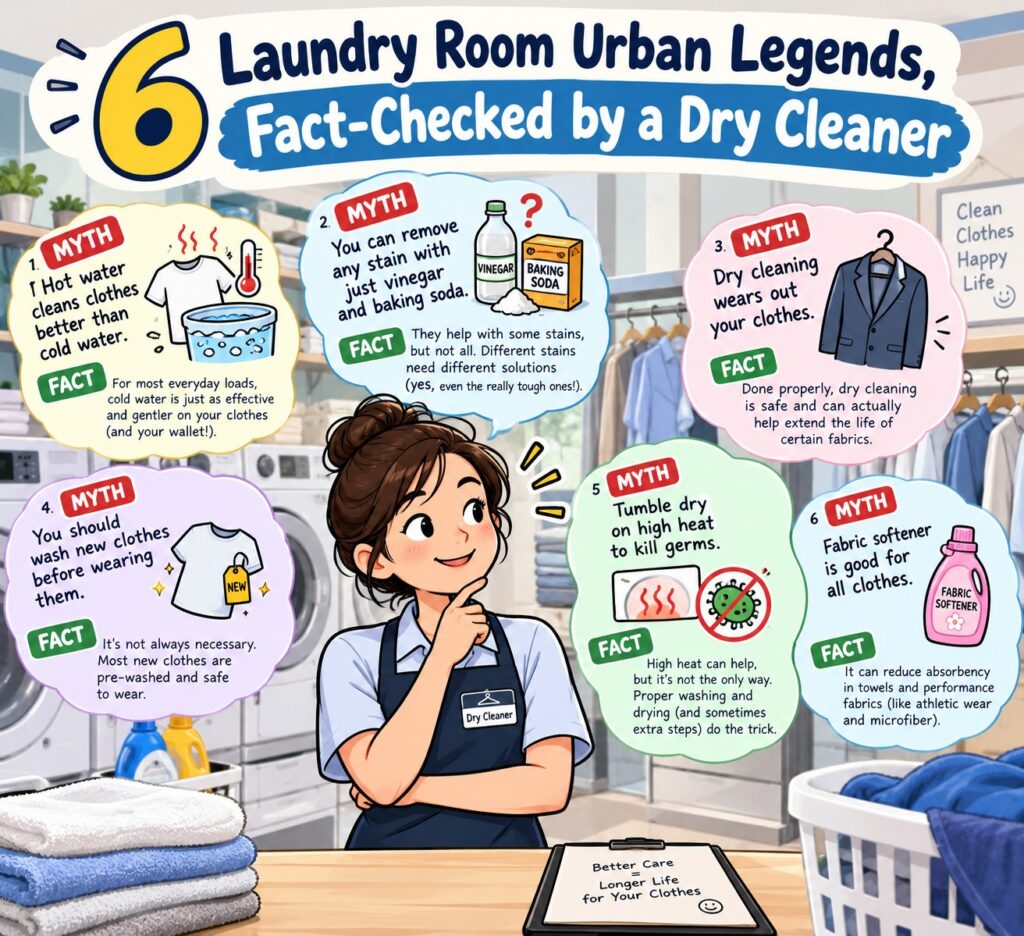
After running a dry cleaning business for 12 years, you hear all kinds of things. About half of what customers tell me as they drop off their clothes — “I heard doing this helps, right?” — turns out to be a baseless belief passed down from our grandparents’ generation, and the other half is “life hacks” that spread around the internet. Today I want to break down six of the most stubbornly persistent misconceptions, both from a chemistry standpoint and from what I’ve actually seen on the job.
1. You Should Always Use Fabric Softener
It’s treated as a laundry rule of thumb, but fabric softener is really just a wax coating agent. It doesn’t actually make fibers softer — it coats the fiber surface with a thin layer of wax so it feels softer.
The problem is that this wax builds up over time, both inside your washing machine and in the fabric itself. In the industry we call this buildup “scrud” — that unidentifiable grayish-white gunk that sticks to your washer’s rubber gasket or filter.
The bigger issue is with towels and athletic wear, where absorbency is everything. When that wax film clogs the fiber’s absorption pores, towels that get repeated fabric softener treatment actually end up absorbing less water over time. It’s a classic case of “feels good, performs worse.”
From the shop floor: Skip fabric softener entirely for towels, activewear, and technical fabrics, and cut back to once or twice a month for everything else.
2. Freezing Jeans Kills Bacteria and Odor
This is a fairly famous urban legend — one that even got a boost when a descendant of Levi Strauss’s founder mentioned it publicly as part of a water-conservation campaign. “Never wash your jeans, just freeze them when they smell” — you’ve probably heard some version of this.
Microbiologically, though, it doesn’t hold up. A standard home freezer sits at around -18°C to -20°C. To actually kill most bacteria, you’d need ultra-low temperatures in the range of -60°C to -80°C. At home-freezer temperatures, bacteria just pause their activity — the moment the jeans warm back up to room temperature, they start multiplying again just fine.
In other words, frozen jeans are just cold jeans. The odor-causing bacteria took a brief nap in the freezer, that’s all.
From the shop floor: If you’re worried about jean odor, hang them inside-out somewhere well-ventilated instead of freezing them. It’s true that denim doesn’t need frequent washing, but that’s because of its tight weave making it harder for bacteria to penetrate deeply — not because freezing does anything.
3. Hairspray Is a Miracle Cure for Ink Stains
This was the go-to stain remedy for homemakers back in the 1950s and 60s. And it actually worked back then — because hairspray at the time had a high alcohol content. The alcohol acted as a solvent that dissolved the dye in ballpoint pen ink.
But modern hairspray formulations have changed completely due to regulations and reformulation — most now have much lower alcohol content, or use a different polymer base entirely. Spray today’s hairspray on an ink stain and the ink stays put while you just add a sticky hairspray stain on top of it.
From the shop floor: For ink stains, isopropyl (rubbing) alcohol on a cotton swab, dabbed from behind the stain onto a cloth in front, is a much more precise approach in principle.
4. Buttoning Up a Shirt Before Washing Keeps Its Shape Longer
This habit comes from a good intention — “keep the shirt’s shape” — but it can actually backfire. As the shirt gets tossed and twisted by the water inside the washing machine, buttoning it up means constant tension gets applied to both the buttonholes and the buttons themselves. The result is often the opposite: buttonholes stretch out or threads snap sooner.
From the shop floor: Button just the top one or two and the cuffs, and leave the rest open to reduce stress on the fabric. If shape retention is your real concern, a mesh laundry bag does far more than buttoning ever will.
5. Vinegar + Baking Soda = A Powerful Natural Cleaner
This is personally my favorite misconception, because it’s one of those rare cases where a real chemical reaction does happen — it just does the opposite of what people think.
Vinegar (acetic acid, pH 2–3) is acidic, while baking soda (sodium bicarbonate) is alkaline. Mix the two and you get an acid-base neutralization reaction, producing carbon dioxide gas (that fizzy bubbling), water, and sodium acetate (basically just salty water).
The catch: this reaction happens between the vinegar and the baking soda themselves — not between either of them and the dirt on your clothes. Once the reaction finishes, the acidic dissolving power of the vinegar and the alkaline deodorizing power of the baking soda have canceled each other out. What’s left is essentially weak salt water. Think back to the classic elementary school volcano experiment with vinegar and baking soda — fun show, zero actual cleaning power.
The reason this myth refuses to die is that the fizzing feels like something powerful is happening. Ironically, that very fizz is a sign that the two ingredients are actively neutralizing each other.
From the shop floor: Use them separately, in different steps, rather than mixing them in one container. For cleaning a washing machine drum, running a vinegar cycle first (to dissolve mineral deposits and mold) and then a separate baking soda cycle (to neutralize odor and provide mild abrasive cleaning) is the chemically correct order.
6. Soaking Jeans in Salt Water Keeps the Dye from Bleeding
This is another denim-care tip that’s spread far and wide. But it’s a bit different from the other five myths on this list — it’s not baseless nonsense so much as real chemistry applied to the wrong situation.
Salt genuinely does play an important role in the dyeing process. Cellulose fibers like cotton develop a negative surface charge in water, and most reactive or direct dyes are also negatively charged. Since like charges repel, you need salt (NaCl) to neutralize that negative charge on the fiber surface with sodium ions before the dye can actually penetrate into the fiber. In textile manufacturing, this is called an “exhausting agent,” and factories use it in significant quantities.
The problem: this reaction only matters while the dye is still dissolved in the liquid dye bath. Soaking an already-dyed pair of jeans hanging in your closet in salt water at home doesn’t recreate that dye-bath environment (concentrated dye solution, salt, specific temperature). There’s no chemical mechanism left to “re-fix” dye that has already settled into the fibers.
On top of that, jeans — especially dark indigo denim — are intentionally dyed shallowly in the first place. Indigo sits more like a coating on the surface of the yarn rather than penetrating to the core, which is exactly why jeans naturally fade with wear and develop their signature fade patterns. In other words, the color loss isn’t a flaw — it’s closer to a designed characteristic of the material itself.
From the shop floor: If you actually want to minimize fading and dye transfer, cold water washing, turning garments inside out, and washing them alone are far more proven methods than a salt soak. If you still want to use salt or vinegar, treat it as psychological comfort more than an effective fix.
Final Thoughts
These misconceptions survive because most of them come with a “plausible story” attached — something fizzes, a famous brand mentioned it, or it’s a method your mom’s generation swore by. But laundry ultimately lives in the realm of chemistry and physics, and once you look past the feel of a method to the actual mechanism, the answer usually turns out to be pretty simple.
Next time someone tells you “apparently doing this works really well,” it might be worth a second thought before you try it.