
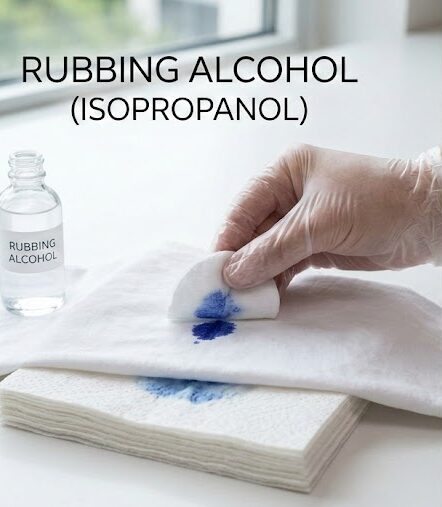
Many people scramble to find home remedies like milk, toothpaste, or hairspray when pen or fountain pen ink ruins a favorite shirt. However, in professional laundry services, the go-to solution is almost always an alcohol-based solvent. It is the most reliable method for breaking down ink without destroying the fabric.
What You’ll Need
– Paper towels
– Rubbing alcohol
– Citric Acid Solution
– Dish soap
Quick Removal Steps
1. Place a thick stack of paper towels under the stained area.
2. Soak a cotton ball with rubbing alcohol and gently blot the stain.
3. Repeat steps 1–2 until most of the pigment is lifted.
4. Apply liquid dish soap to the area.
5. Wash.
The Most Effective Way to Remove Ink at Home
The process is remarkably simple, but the technique is what matters most. The golden rule is to dab, never rub. Following this professional approach will significantly increase your success rate.
Prepare a Protective Layer
Place a thick stack of paper towels directly under the stained area. This prevents the ink from bleeding through to the other side of the garment and allows the loosened pigment to be absorbed downward into the paper.
Alcohol Dab Instead of Rubbing
Soak a cotton ball or pad with rubbing alcohol (Isopropanol) and gently tap the stain. Rubbing forces the ink deeper into the fibers and spreads the mess outward. By dabbing, you will notice the ink physically transferring from the fabric onto the paper towels below.
Finish with Dish Soap
Once the majority of the pigment has been lifted, apply a small amount of liquid dish soap to the area. Gently work it in with your fingertips to break down any remaining oily residues, then rinse or launder as usual.
Why Rubbing Alcohol is the Safest Choice
For most ink disasters, isopropyl alcohol is the superior solvent for several scientific reasons.
Superior Ink Solubility
Most ballpoint and fountain pen inks are formulated to be soluble in alcohol. It acts quickly to break the bond between the pigment and the fabric, making it much easier to lift even stubborn, dried-in marks.
Gentle on Most Fabrics
Alcohol evaporates quickly and leaves behind very little residue. This makes it safe for a wide range of materials, including polyester, nylon, cotton, and common blends, where harsher chemicals might cause damage.
Deep Fiber Penetration
The low surface tension of alcohol allows it to sink deep into the weave of the fabric. This lifts the ink particles to the surface, where they can be easily captured by your absorbent backing.
The Hidden Dangers of Using Nail Polish Remover
While many online tips suggest using nail polish remover (acetone) to tackle ink, it comes with significant risks that could permanently ruin your clothes.
Risk of Melting Synthetic Fibers
Acetone is a powerful solvent that can actually dissolve certain synthetic fabrics like acetate or triacetate. Using it on these materials can result in the fabric becoming sticky, thinning out, or even developing holes.
Potential for Severe Discoloration
Unlike alcohol, acetone is aggressive enough to strip away the original dyes of your clothing. This increases the risk of leaving a permanent bleached spot or a faded patch where the stain used to be.
Contaminants in Commercial Removers
Most nail polish removers are not pure acetone. They often contain fragrances, dyes, and moisturizing oils. These additives can leave behind secondary oil stains that are sometimes harder to remove than the original ink.
🧺 Pro Tip from a Dry Cleaner
If you remember nothing else, remember this: friction is the enemy of ink removal. Rubbing an ink stain almost always makes it worse by spreading the pigment. Stick to the dabbing method, and you will save your clothes more often than not.
When an ink stain is extremely heavy or thick, achieving complete removal is often unrealistic. Ink pigments tend to bind tightly to fabric fibers, and breaking them down requires repeated flushing with alcohol-based solvents. In severe cases, the amount of alcohol needed becomes excessive, and the process must be repeated many times to gradually dissolve and lift the ink. More importantly, the time required to work through such a dense stain can become impractically long. For this reason, while partial improvement is often possible, expecting a perfectly clean result from a very large or deeply saturated ink stain is not always realistic, even with proper professional treatment.