
Washing a down jacket at home is possible — but most people make at least one mistake that leaves the jacket flat, stiff, or still smelling after drying.
Many people use a laundry bag to protect their down jackets. From a professional standpoint, this often does more harm than good. A laundry bag restricts movement inside the washer, which means water and detergent can’t circulate properly. In real cases, this leads to poor rinsing, trapped detergent, and even lingering odor after drying.
If you want your jacket to come out truly clean—not just “washed”—the process needs to be approached differently.
Start Where Washing Usually Fails
The biggest mistake people make is assuming the washing machine will do all the work.
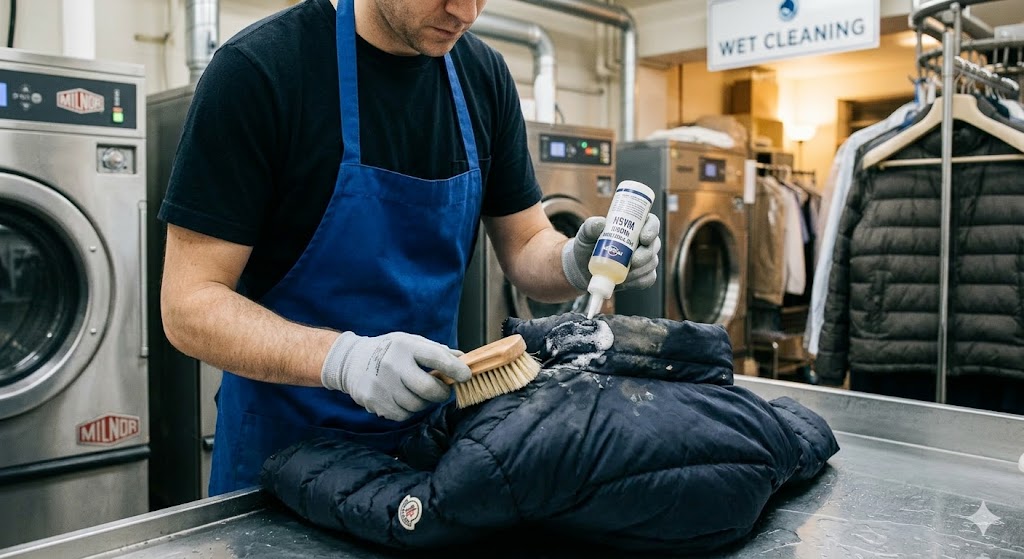
In reality, the areas that need the most attention—collar and cuffs—are also the areas least likely to come clean in a normal cycle. These spots are heavily coated with body oils, which bind to fabric and resist water-based cleaning.
Before washing, apply a small amount of detergent directly to these areas and gently work it in with a soft brush.
Let it sit briefly so it can break down the oil.
This step alone often makes the difference between a jacket that still smells and one that actually feels clean.
Why Washing It Alone Matters More Than You Think
A down jacket should always be washed by itself.
When mixed with other laundry, the jacket loses the space it needs to move freely. This affects more than just cleaning—it directly impacts rinsing.
From a cleaner’s perspective, restricted movement = detergent left inside the down.
And that leftover detergent is one of the most common causes of:
- stiffness
- reduced loft
- unpleasant odor after drying
The Truth About Laundry Bags
Laundry bags are meant to protect delicate fabrics, but down jackets behave differently.
Because of their bulk and structure, they rely on full water circulation. A laundry bag limits that flow, which means:
- less effective cleaning
- incomplete rinsing
- higher chance of residue buildup
Instead of using a laundry bag, simply:
- close all zippers and Velcro
- protect sharp trims if needed
This keeps the jacket safe without sacrificing cleaning performance.
The Step Most People Get Wrong: Rinsing
If there’s one step that matters most, it’s not washing—it’s rinsing.
Down acts like a sponge. It traps detergent deep inside, and a single rinse cycle is almost never enough.
In many real cases, jackets that “smell after drying” were actually never fully rinsed.
Run multiple rinse cycles—ideally three or more.
Then repeat the spin cycle a few times to remove as much internal moisture as possible.
This step is what separates a properly cleaned jacket from one that just looks clean.
Drying Is About Control, Not Heat
High heat is one of the fastest ways to damage a down jacket.
Instead of forcing the drying process, focus on gradually removing moisture and restoring loft.
Start with low heat to release internal moisture, then finish with a short medium-heat cycle to bring back volume.
If the jacket still feels slightly heavy or uneven, it likely still holds moisture inside.
Short additional drying cycles will help restore its full loft.
When Home Washing Isn’t Enough
Even with the right method, there are limits.
If the jacket:
- still smells after proper rinsing
- feels heavy or clumped after drying
- has deep oil buildup
then home washing may not fully resolve the issue.
At that point, professional cleaning becomes less about convenience and more about restoring the structure of the down itself.
Final Thoughts
Cleaning a down jacket properly isn’t about being gentle—it’s about being precise.
The biggest differences come from:
- proper pre-treatment
- enough rinsing
- controlled drying
Skip the laundry bag, give the jacket room to move, and focus on removing what’s inside—not just what’s on the surface.
That’s what actually keeps a down jacket clean, light, and long-lasting.
You may also find this helpful:
Stop Dry Cleaning Your Bedding: The Best Way to Wash Down Comforters