
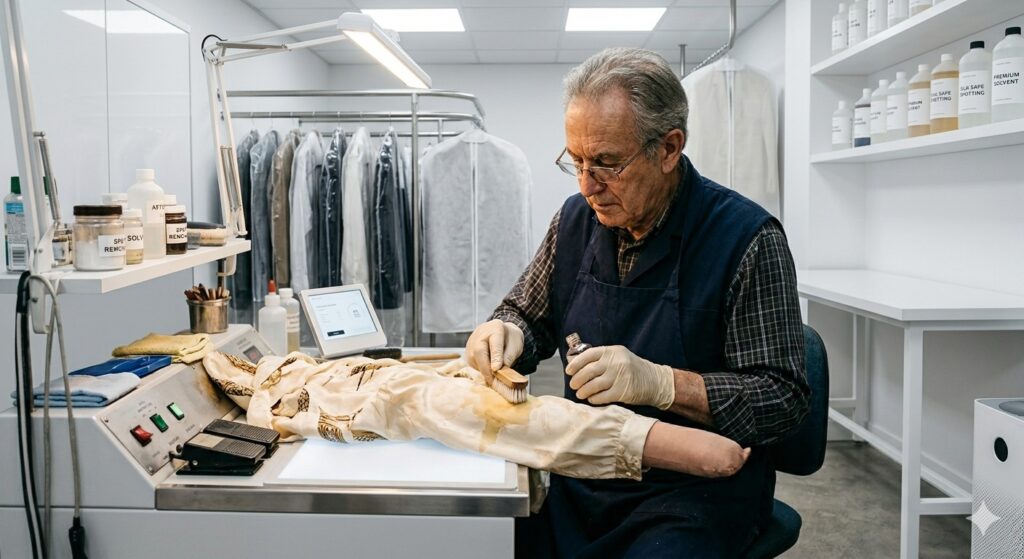
To give you the bottom line right away: when it comes to stains, time is your ultimate enemy. Working in the dry cleaning industry, I regularly encounter stains that we simply have to give up on—no matter how advanced our chemicals or techniques are—purely because of how much time has passed. Today, I want to share the honest truth about stain removal.
Time vs. Removal Rate
Stain Removal Likelihood by Elapsed Time The figures below are rough estimates based on common everyday spills (coffee, food, beverages, etc.). Actual results vary significantly depending on the stain type and fabric material.
| Elapsed Time | Stain Condition & Characteristics | Removal Success Rate |
|---|---|---|
| Immediate (Within 5 mins) | The stain sits only on the fabric surface. Most can be completely resolved by diluting immediately with cold water. | 90%+ |
| Same Day (Within a few hours) | The stain begins to penetrate the fibers. Most can be removed using a proper pre-treatment agent. | 75% – 85% |
| 1 – 3 Days | Oxidation and drying are underway. Professional treatment is required, and faint traces may remain. | 50% – 70% |
| 1 – 2 Weeks | Chemical setting progresses. The stain begins bonding with the fibers. Traces are highly likely to remain. | 30% – 50% |
| 1 Month+ | The stain has chemically bonded deep within the fiber structure. Complete removal is nearly impossible; partial improvement is the realistic goal. | 10% – 25% |
| Several Months+ | The stain is virtually permanent. This is a stage where even professionals find it incredibly difficult to help. | ~5% |
※ These percentages are industry-experienced estimates for standard food and beverage spills. The timeline changes completely depending on the specific type of stain.
Characteristics by Stain Type
What was spilled matters just as much as when it happened. Identifying the substance is crucial for a successful outcome.
Coffee / Tea (Easy initially, but deceptive)
This is the most commonly misunderstood type of stain. When fresh, it washes out easily with just water. However, if left untreated, it oxidizes rapidly and turns into a permanent yellowish-brown mark. The mindset of “I’ll just get the coffee stain out later” is the most dangerous approach.
Wine / Fruit Juice (Highly time-sensitive)
A prime example of an oxidizable stain. If treated on the same day, most can be completely removed using bleaching agents. Once 48 hours pass, the tannins bond tightly with the fabric fibers, skyrocketing the difficulty. Options shrink even further for silk or wool, as you cannot use standard bleaching products on them.
Blood (Cold water is the ultimate key)
The textbook example of a protein-based stain. Never use hot water—heat coagulates the proteins, setting them permanently into the fabric. Rinsing immediately with cold water yields an incredibly high success rate. Dried blood requires enzymatic cleaners to break down, and the success rate drops sharply over time.
Oil / Butter (Dangerous because it’s invisible)
The trap here is that oil stains are often barely visible at first. They lie dormant through a regular wash, only to oxidize and rear their ugly heads as bright yellow spots during the heat-treatment phase of dry cleaning. A massive percentage of customer complaints claiming “a new stain appeared after washing” fall into this exact category.
Pens / Ink (Inherent high difficulty)
Because ink is dye-based, it is incredibly tough to remove from the get-go. Treating it immediately with alcohol-based solvents can dilute it to some extent, but complete removal often comes down to fabric type and pure luck. Once it sets, a noticeable shadow will likely remain even after professional treatment.
Sweat / Yellowing (Long-term accumulation)
It’s not the sweat itself that causes the issue, but the accumulated proteins and minerals. Underarm yellowing builds up silently over a long period. It remains invisible at first but suddenly darkens and appears after exposure to heat. Yellowing that has chemically reacted with deodorant ingredients is notoriously difficult to reverse.
🚫 Hair Dye — The Stain That Makes Dry Cleaners Give Up
Let me be completely honest: hair dye is classified in our industry as virtually impossible to remove.
- The very purpose of hair dye is to permanently change the color of organic fibers. Because clothing fibers share a similar structure to human hair, the dye penetrates deep into the core.
- The oxidative color-developing process finishes within minutes. By the time you attempt to wipe it off, the permanent discoloration has already begun.
- The chemical agents required to break down hair dye (reducers, heavy bleaches) carry an incredibly high risk of stripping the garment’s original color and destroying the fabric structure.
Attempting to fix it usually leads to “further damage” rather than “improvement,” which is why most professionals advise against treating it at all.
Conclusion: Always wear old, disposable clothes when dyeing your hair. The moment it touches the fabric, that clothing has officially changed color permanently.
On-the-Field Tips: What to Do Right This Second
- TIP 01 — Do Not Rub Rubbing spreads the pigment across a wider area and pushes the particles deeper into the fiber matrix. Always blot or press. Your first move should be placing a white cloth or paper towel over the spot to absorb the liquid upward.
- TIP 02 — Steer Clear of Hot Water (For Protein Stains) Pouring hot water on protein-based stains like blood, eggs, or milk is the worst possible move. The heat cooks the protein, locking it in forever. Always dilute and flush with cold water first.
- TIP 03 — Always Declare the Stain’s Location & Type When Dropping Off Clothes If a dry cleaner doesn’t know exactly what was spilled and where, the stain can get baked in permanently during our automated pressing and heat-treatment cycles. Please make sure to point out any hidden oil, beverage, or makeup stains at the counter.
- TIP 04 — Always Wash Clothes Before Seasonal Storage Even if a garment looks perfectly clean right now, invisible organic residue can oxidize into nasty yellow blotches over a year spent in your closet. Washing your clothes before storing them away isn’t optional—it’s an absolute necessity.
Conclusion: The Battle Against Stains is All About Timing
In the fight against stains, the most powerful weapon isn’t a secret chemical formula or cutting-edge machinery. It is speed. Acting the exact moment a spill occurs shifts your success rate by tens of percentages. If you’re ever unsure of how to handle a specific fabric, your best bet is to get it into the hands of a professional as fast as humanly possible.