
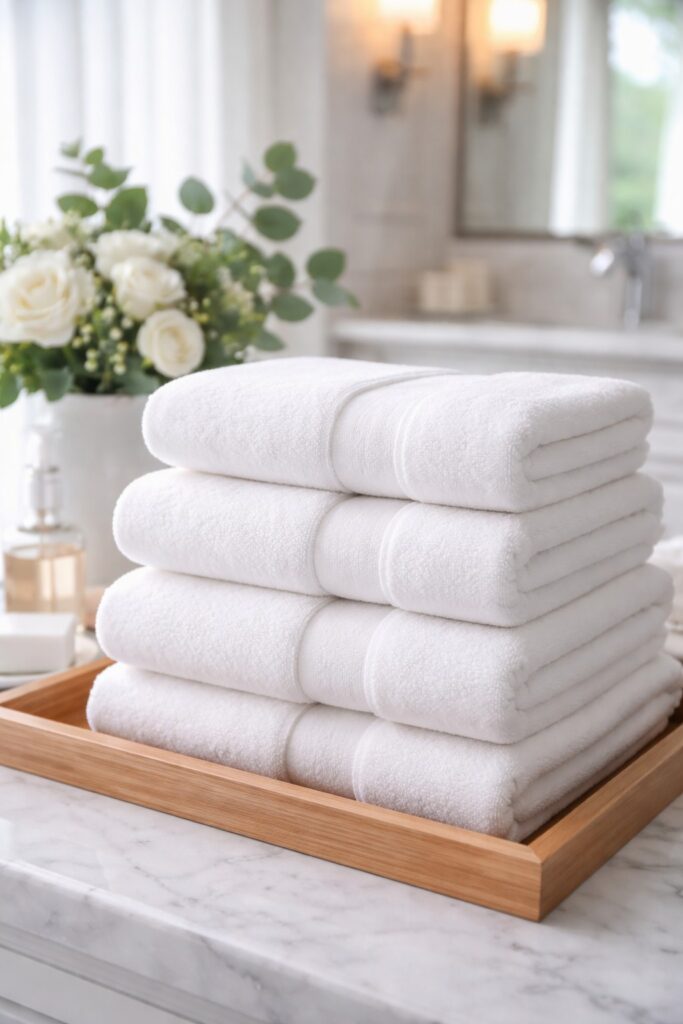
Have you ever wondered why hotel towels feel like a warm hug, while your towels at home eventually turn into something resembling sandpaper? It is not just about the brand; it is a combination of material quality, specific chemical balances, and specialized drying techniques.
Here is the breakdown of why hotel towels stay fluffy and how you can replicate that luxury in your own bathroom.
1. The Quality of the Fabric (GSM and Thread Type)
The foundation of a soft towel begins long before it ever touches a washing machine. Hotels invest in a specific grade of cotton that is rarely found in standard department stores.
The Use of Combed Cotton
Most high-end hotels use Combed Cotton. This process involves “combing” out short, uneven fibers and debris, leaving only the longest and strongest threads. Long-staple cotton results in a smoother surface and significantly less linting over time.
Optimized GSM (Grams per Square Meter)
Weight matters. Standard home towels usually range between 300 to 400 GSM. Hotel towels are typically 600 to 800 GSM. This higher density provides that signature “heavy” and “plush” feel that absorbs water instantly without becoming soggy.
2. The Detergent Strategy: Less is More
One of the biggest mistakes people make at home is using too much detergent. While it seems intuitive that more soap equals cleaner towels, the opposite is true for softness.
Avoiding Chemical Buildup
When you use excessive detergent, the rinse cycle cannot wash it all away. The leftover soapy residue dries inside the fibers, causing them to stiffen. Hotels usually use about 70% of the recommended detergent amount to ensure a clean rinse.
The pH Balance and Neutralization
Hotels often use mild alkaline detergents to break down body oils but follow up with an acidic rinse (like a citric acid solution) to neutralize the pH. At home, you can achieve this by adding half a cup of white vinegar to the final rinse cycle instead of fabric softener.
3. Why Fabric Softener is Actually the Enemy
It sounds counterintuitive, but fabric softeners are the primary reason towels lose their fluff and absorbency.
The Silicone Coating Problem
Fabric softeners work by coating fibers with a thin layer of wax or silicone. While this feels soft initially, it builds up over time, flattening the loops of the towel and making it “water-repellent.” Hotels skip the softener to keep the cotton loops open and thirsty for water.
4. The “Wool Cycle” vs. Deep Cleaning
There is a common concern that gentle cycles won’t get towels clean enough. However, towels rarely have “set-in” stains; they mostly carry skin cells and moisture.
Protecting the Loops
Standard heavy-duty cycles involve aggressive agitation that crushes the cotton loops (piles). Using a “Wool” or “Delicate” cycle with an “Extra Water” or “Deep Rinse” setting allows the towels to float freely. This prevents the mechanical friction that leads to fraying and stiffness.
** To get rid of smelly towels, you need to use sufficient alkaline detergent and high-temperature washing, because the odor is caused by the oxidation of body oils.
5. The Magic of the Drying Process
The way a towel dries is the final step in determining its texture. This is where hotels have a massive advantage with industrial equipment.
Constant Airflow
Industrial dryers use high-volume airflow to toss the towels. This mechanical action “beats” the fibers, forcing the cotton loops to stand upright rather than laying flat.
Avoiding High Heat and Over-Drying
Extreme heat makes cotton fibers brittle. Hotels dry towels at a medium temperature and remove them while there is still a tiny hint of moisture (about 95% dry) to prevent the “crispy” texture caused by over-drying.
Conclusion: When is it Time to Replace?
Even with the best care, towels have a lifespan. Most hospitality experts recommend replacing towels every 6 to 12 months if they are used daily. Once the fibers are physically worn down and the loops are broken, no amount of vinegar or drying will bring back that hotel-grade plushness.
You may also find this helpful:
The Fabric Softener Myth: Why I Stopped Using It in My Laundry Business