
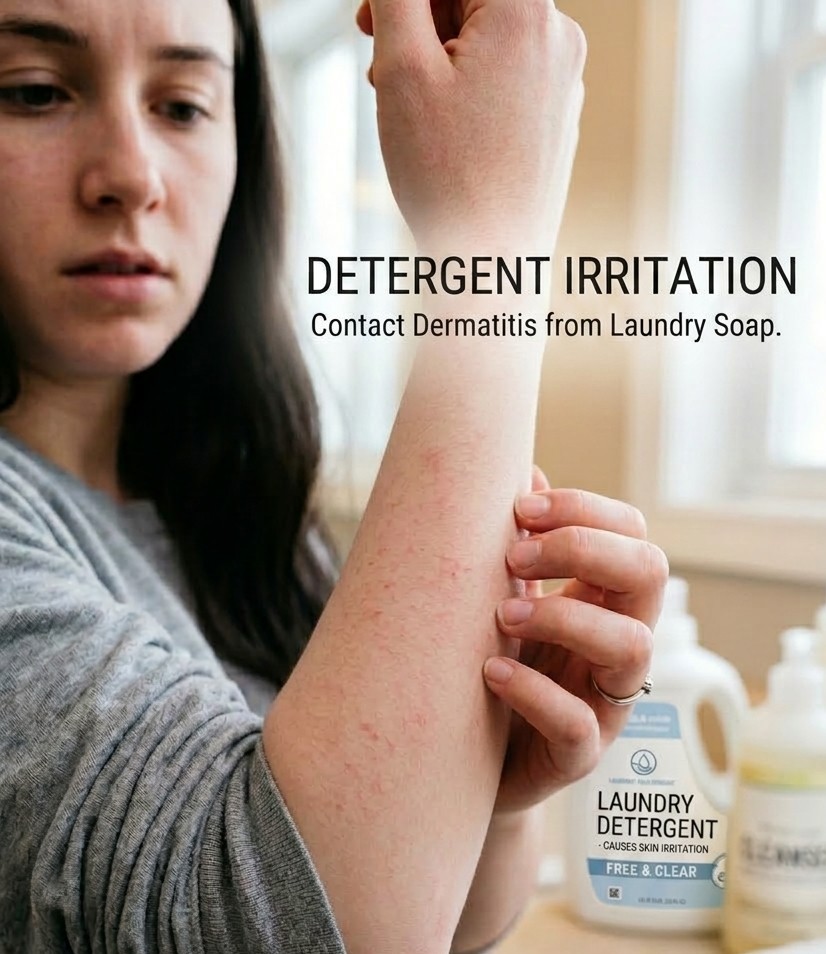
People who experience skin irritation from laundry products often become very careful about the detergents they choose. It can feel confusing. The same detergent that makes clothes look bright and clean can also cause itching, dryness, or rashes on the skin.
At the same time, switching entirely to expensive plant-based detergents is not always realistic for many households. A better approach is understanding which ingredients can irritate the skin and learning how to use different products in a smarter way.
Ingredients in Fabric Softeners That May Irritate Skin
Fabric softeners make clothes feel smoother and reduce static, but several ingredients used in these products can trigger skin sensitivity.
Cationic Surfactants
Common examples include compounds such as distearyldimethylammonium chloride and esterquats.
Their primary role is to coat fabric fibers. This coating reduces friction, makes clothing feel softer, and helps prevent static electricity.
The issue is that these chemicals can partially strip away the skin’s natural lipid barrier. When that protective layer is weakened, the skin can become dry, itchy, or irritated. People with sensitive or eczema-prone skin are especially likely to react.
Fragrance
Most fabric softeners contain complex blends of synthetic fragrance chemicals.
Fragrance ingredients are among the most common causes of contact allergies in household products. When clothing that still carries fragrance residue touches the skin for long periods, some people may develop itching, redness, or mild rashes.
For individuals with sensitive skin, fragrance-free products are usually the safer choice.
Preservatives
Preservatives are added to prevent microbial growth inside liquid products.
Ingredients such as methylisothiazolinone (MIT) or certain benzoate compounds are widely used in personal care and cleaning products. Some preservatives, however, have been linked to allergic contact dermatitis, especially with repeated exposure.
Additional Additives
Fabric softeners may also contain colorants or scent-binding agents designed to help fragrance last longer on fabric. While these additives are generally safe for most people, individuals with sensitive skin may occasionally react to them.
Ways to Reduce Skin Irritation From Fabric Softeners
Reducing irritation does not always require eliminating fabric softener entirely.
Choose low-irritation formulas
Products labeled fragrance-free or designed for sensitive skin often contain fewer potential irritants. Or use a citric acid solution instead of fabric softener during the rinse cycle.
Rinse clothing thoroughly
Running an extra rinse cycle can significantly reduce the amount of residue left in fabrics. This simple step often helps when skin reactions are mild.
Why Regular Laundry Detergents Can Be Harsh on Skin
Most standard powder or liquid laundry detergents are alkaline, usually with a pH between 9 and 11.
This alkalinity improves cleaning power, but it can also affect skin comfort.
Strong surfactants
Conventional detergents often rely on petroleum-derived surfactants such as linear alkylbenzene sulfonate or alcohol sulfate.
These ingredients are very effective at breaking down oils, grease, and dirt. However, they can also dissolve part of the skin’s natural lipid barrier if residue remains on clothing.
High alkalinity
Human skin functions best in a slightly acidic environment, around pH 5.5.
When alkaline detergent residues remain in fabric, prolonged skin contact can disrupt that natural balance. The result may be dryness, irritation, or itching.
Optical brighteners and fragrance
Optical brighteners are chemicals that make fabrics appear whiter by reflecting blue light. Artificial fragrances are also commonly added to detergents.
Both ingredients can trigger allergic reactions in people with sensitive skin.
Are Neutral or Plant-Based Detergents Gentler?
In many cases, they are. There are several reasons why these detergents tend to be milder on skin.
Balanced pH
Neutral detergents typically fall between pH 6 and 8. Because this range is closer to the natural pH of skin, small residues left after washing are less likely to disturb the skin barrier.
The same principle explains why delicate fabrics such as wool or silk are washed with neutral detergents.
Milder surfactants
Plant-derived surfactants are often made from sources such as coconut oil or sugar-based compounds.
Their molecular structure tends to be gentler, allowing them to remove soil while being less aggressive toward skin proteins.
Safer residue profile
Many plant-based ingredients are more biodegradable and rinse away more easily during washing. Even when tiny residues remain, their toxicity to skin is generally lower than that of harsher synthetic detergents.
A Lesser-Known Issue With Some “Natural” Detergents
Even plant-based or neutral detergents are not completely free from controversy.
One compound sometimes discussed in safety reports is 1,4-dioxane. This substance is not intentionally added to detergents. Instead, it can appear as a trace byproduct during a manufacturing process called ethoxylation, which is used to enhance cleaning performance.
The U.S. Environmental Protection Agency classifies 1,4-dioxane as a potential carcinogen. In the past, trace amounts were detected in several natural cleaning brands, including Seventh Generation, which sparked debate about ingredient transparency in the green-cleaning industry.
Today, many manufacturers have reduced these trace levels significantly, but the discussion highlights how complex detergent chemistry can be.
A Practical Approach to Choosing Detergent
Many households notice that traditional detergents clean extremely well, while plant-based products feel more comfortable for sensitive skin.
Instead of choosing only one, a more practical solution is using each detergent where it works best.
Separate laundry by purpose
Clothes exposed to outdoor dirt and heavy sweat often benefit from stronger detergents.
Work clothes, sportswear, socks, and heavily soiled garments can be washed with powerful formulas such as those from Tide.
Garments that stay in direct contact with the skin for long periods may be better washed with milder detergents. Underwear, sleepwear, bedding, and children’s clothing are good candidates for plant-based or neutral detergents like those from Ecos or Seventh Generation.
Use targeted stain treatment
When a garment has heavy stains, applying a small amount of a strong detergent (shout spray) directly to the stain before washing can improve cleaning performance.
After pretreating the stain, the full wash cycle can still be run with a milder detergent.
This method combines effective stain removal with reduced chemical exposure.
When Using Only Mild Detergents Can Cause Another Problem
One overlooked issue appears when households use only mild or neutral detergents for long periods without cleaning the washing machine.
Because these detergents are gentler and often used in cold-water cycles, residues from body oils and detergent can gradually accumulate inside the machine.
Over time, this buildup can lead to odors or bacterial growth.
Regular washing machine maintenance helps prevent this. Running occasional hot cycles or dedicated machine-cleaning cycles keeps the washer interior clean and prevents hidden contamination.
The Key Takeaway
Conventional detergents achieve strong cleaning power partly by breaking down oils aggressively, which can also affect the skin barrier.
Neutral or plant-based detergents generally respect the skin’s natural pH and use milder surfactants, making them more comfortable for sensitive skin.
Rather than relying on a single product, using different detergents for different types of laundry can provide the best balance between cleaning performance, skin comfort, and cost.